Docs · Overview
Rapid Stacker documentation
Rapid Stacker turns your raw astrophotography sub-frames into calibrated, registered, plate-solved master stacks — the same job as PixInsight’s Weighted Batch Preprocessing (WBPP), but GPU-accelerated and about 3× faster.
Every run walks the same pipeline:
Rapid Stacker deliberately replaces WBPP, not PixInsight. It stops where preprocessing stops: post-processing steps such as SPCC, deconvolution, and gradient removal remain the job of your processing suite. To make that hand-off seamless, the finished masters are (by default) XISF files that carry PixInsight’s native AstrometricSolution properties — SPCC and SpectrophotometricFluxCalibration work on them directly, no re-solving needed. Prefer Siril, ASTAP, or APP? Switch Settings → Output to FITS and every finished file is written as 32-bit float FITS with full provenance and WCS keywords instead — or, since 1.8.3, to one of the two tile-compressed .fits.fz options (lossless GZIP tiles, or fpack-style Rice with q=4 quantisation). Inputs may likewise be fpack-compressed .fz frames: integer .fz lights and calibration frames stream tile-by-tile with no extra memory.
Every stage is included — GPU drizzle, offline plate solving, distortion correction, multi-session alignment, and mosaic assembly — with unlimited frames and no license file; see Features & support.
Where to start
- Getting started — installation, requirements, and your first stack in six steps.
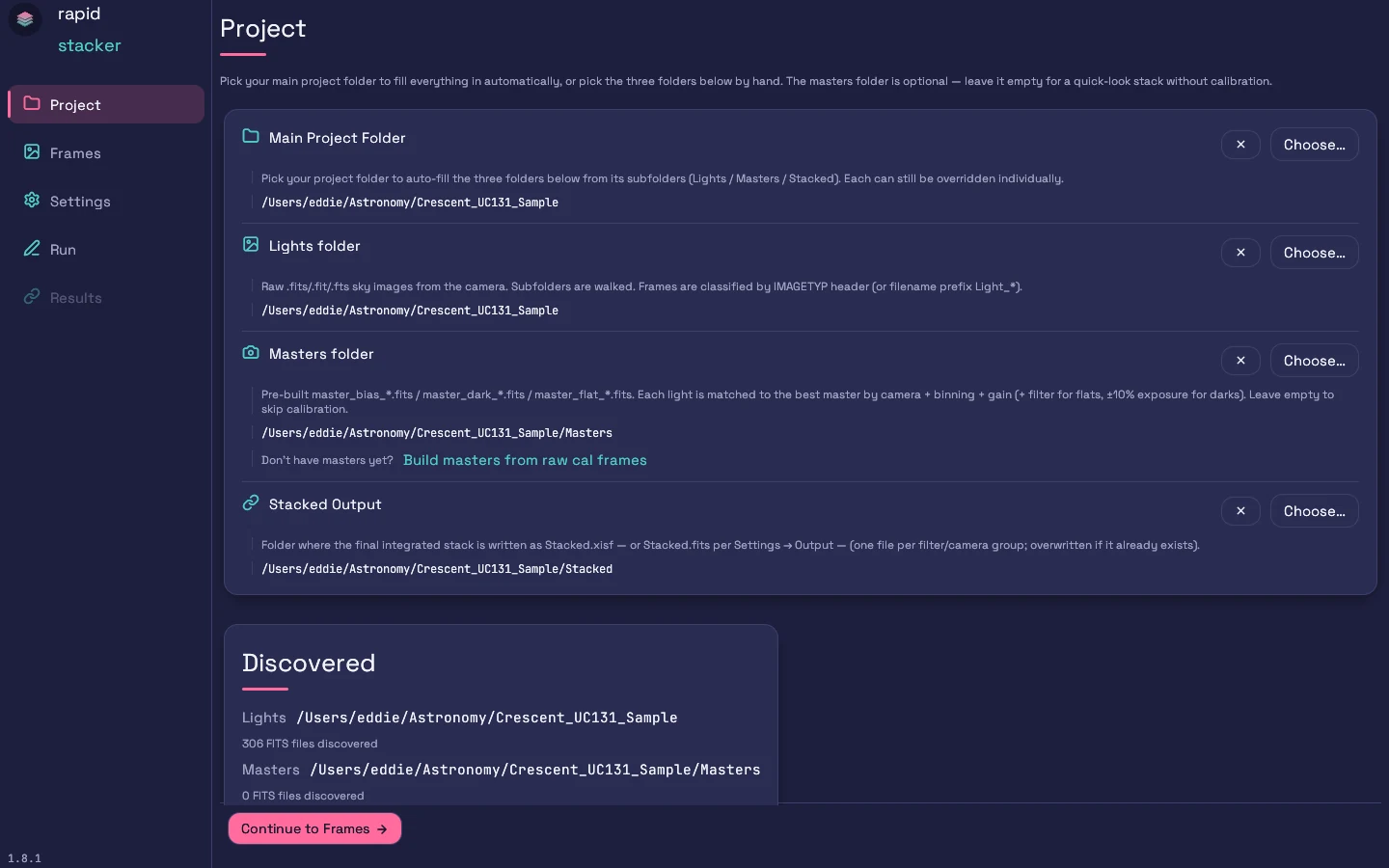
- Project & frames — pointing the app at your data and inspecting frames before stacking.
- Building masters — combining raw bias / dark / flat sub-frames into master calibration files.
- Settings reference — every pipeline control, its default, and when to change it.
- Running a stack — what happens during a run and how to read the results.
- Features & support — what’s included, and how to support development.
- Troubleshooting & FAQ — common issues and current limitations.
- CLI & output formats — scripting with
rapid-stacker-cli, and what the output files contain.
Performance
On a published reference benchmark (1,081 frames × 61 MP, 7 filters, 19 sessions of M31), Rapid Stacker finished in about 2.75 hours where WBPP took 8.5 hours on the same machine — about 3× faster, with similar quality. GPU acceleration changes speed, never the output: the CPU path produces identical results.
This documentation describes Rapid Stacker v1.6.0. For downloads, see the download section; to chip in, see Support development.