GPU astrophotography stacking software

The whole WBPP job, rebuilt for the GPU.

Every run walks one pipeline: discover → classify → group → build masters → calibrate → debayer → register → weight → normalize → reject → integrate / drizzle → plate-solve → write XISF (or FITS). On our M31 reference set (1,081 frames × 61 MP, 7 filters, 19 sessions) that takes about 2.75 hours where PixInsight’s WBPP took 8.5 hours — with similar quality. Here’s each stage, end to end.

Download free Read the docs

Calibration

Masters built right, per night.

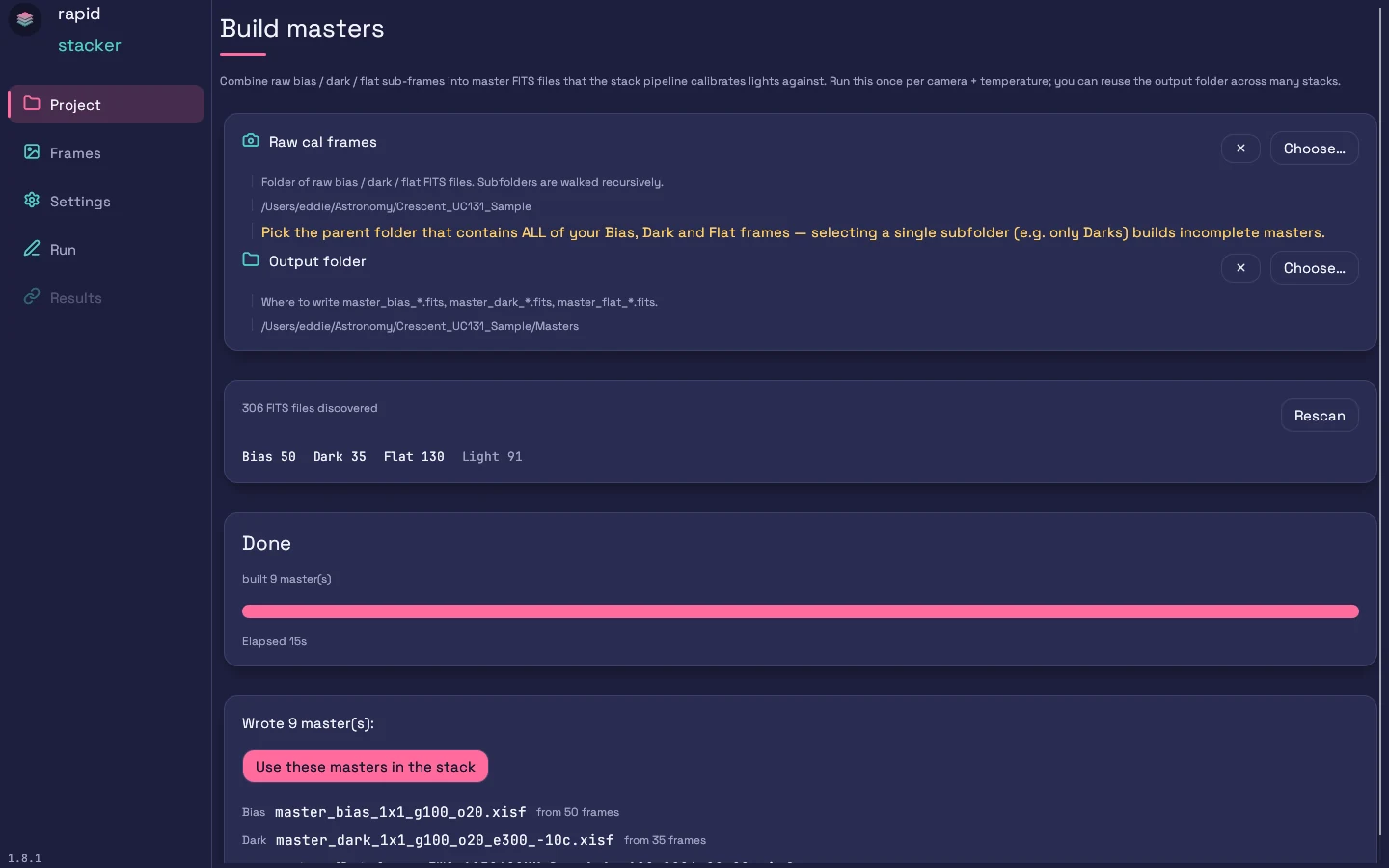
Master bias, dark, flat, and dark-flat construction with automatic dark-flat detection. Per-session flats (on by default) build one master flat per observing night and calibrate each light against the flat nearest in time — no more one-flat-fits-all across a 19-night project. Cosmetic hot/cold-pixel correction, optional dark-scale optimization for uncooled cameras, and loose master matching by nearest exposure and temperature.
How Build Masters works →

Build Masters complete: 39 masters from 1,669 frames in 99 seconds

Debayer & OSC

True CFA drizzle for colour cameras.

Four debayer algorithms — superpixel, bilinear, Malvar (the default; a quality method PixInsight doesn’t offer), and VNG (a port of PixInsight’s own default) — with GPU paths for bilinear and Malvar. Output luminance, a combined RGB master, or RGB plus separate R/G/B channel masters.

True CFA/Bayer drizzle scatters raw Bayer samples directly into their colour planes, matching WBPP’s drizzle-2× colour workflow — with an optional simultaneous non-drizzle colour-reference master so photometric colour calibration stays reliable.

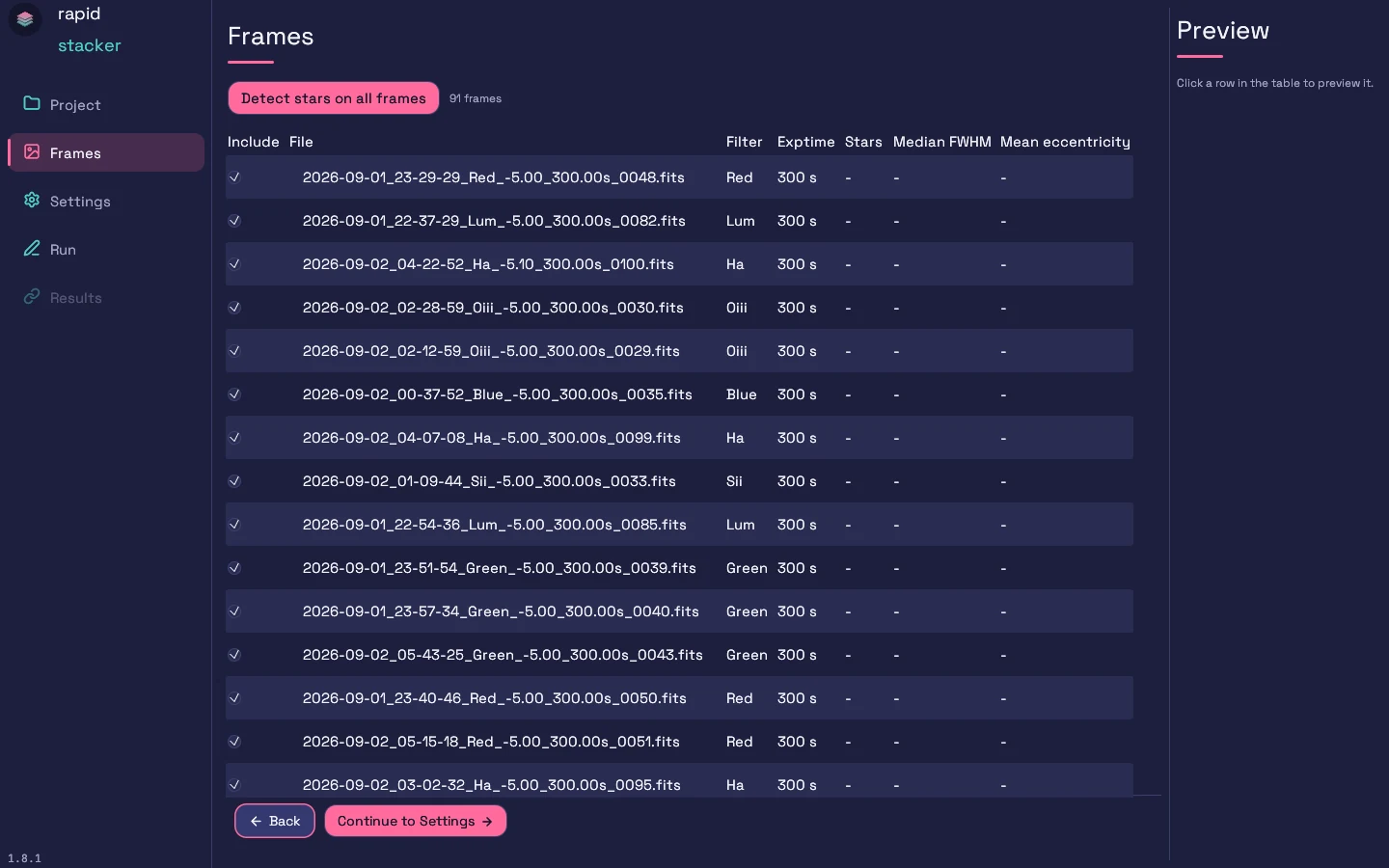
The Frames screen with per-frame star counts, FWHM, and eccentricity

Registration

Star-matched, distortion-aware, flip-proof.

SExtractor-style star detection → triangle matching over a KD-tree → RANSAC-fitted affine or projective transform → GPU warp with your choice of kernel, from nearest through Lanczos-5 (default Lanczos-3 with a PixInsight-style de-ringing clamp). Elliptical-Gaussian PSF refinement of star positions, automatic best-reference selection, correct handling of meridian-flipped sessions, and a phase-correlation fallback for star-poor frames.

Optional thin-plate-spline distortion correction fits the residual field distortion the linear model can’t.

Weighting & quality gates

Every frame earns its weight.

Nine weighting schemes — uniform, inverse-noise, exposure, FWHM, eccentricity, star count, SNR, PSF flux, and PSF signal weight (the default, the same philosophy as modern WBPP). Statistical outlier gates on FWHM and eccentricity drop bloated or trailed frames before they smear the stack.

Normalization & rejection

Seven rejection algorithms, PixInsight-parity.

Per-tile local background normalization (with multiplicative scale matching — essential for clean meridian-flip sessions) runs on both the warp and drizzle paths, so sky-gradient changes never masquerade as outliers. Then pick your rejection: sigma clip, Winsorized, linear fit, generalized ESD, and PixInsight-parity percentile, averaged sigma, and min/max.

Every knob, documented →

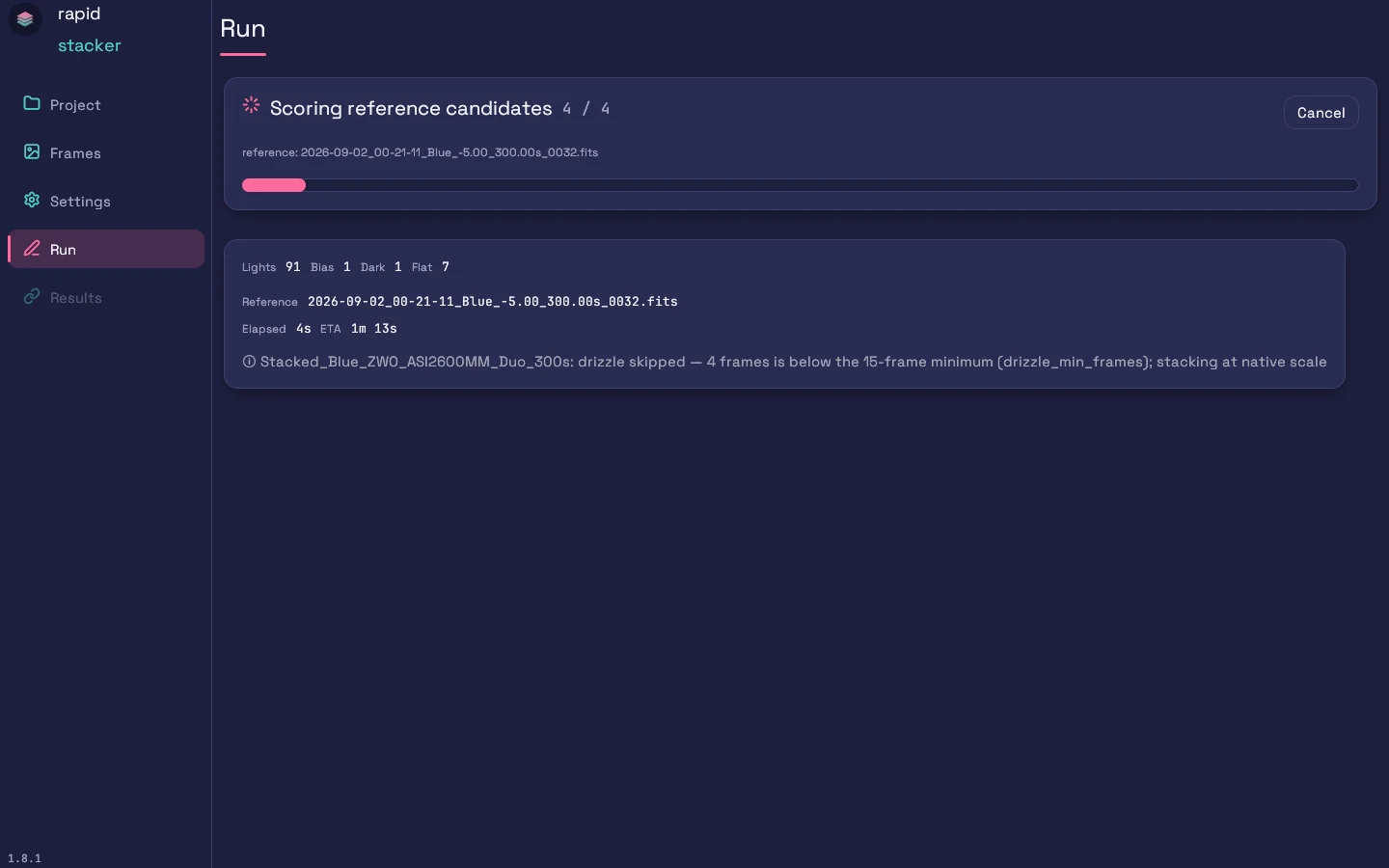
A stack in progress with live pipeline phases and preview

Integration & drizzle

Super-resolution from your dithers.

CPU reference integrator plus wgpu and CUDA GPU paths with graceful fallback — identical results on all three, the GPU just gets there faster. Fruchter–Hook variable-pixel drizzle at 2×/3× with square, point, circular, or Gaussian drop kernels, three-pass cosmic-ray-style rejection, and GPU-accelerated scatter.

Astrometry

Plate-solved, SPCC-ready output.

Hinted WCS plate solve against Gaia DR3 — online cone search or a fully offline local XPSD catalog, no network needed. Fits a TAN projection with an optional SIP distortion polynomial and writes both standard FITS WCS keywords and PixInsight’s native AstrometricSolution XISF properties, so SPCC and SPFC work on the master directly — no re-solving in PixInsight.

Multi-session & multi-filter

Every master, pixel-aligned.

Cross-group alignment registers every filter and session group to one global reference so all masters come out mutually pixel-aligned — like WBPP’s cross-channel registration — followed by WBPP-style auto-crop with a configurable coverage fraction. Drop seven aligned filter masters straight into channel combination.

Mosaics

Panels in, one image out.

Multi-panel mosaics are detected automatically — NINA-style “Panel 1” OBJECT names, panel folders, or distinct pointings — and each panel stacks into its own clean master. Mosaic assembly then stitches each filter’s panels into one seamless image: WCS placement star-refined at the overlaps, additive sky matching, feathered seams, and a full astrometric solution on the result.

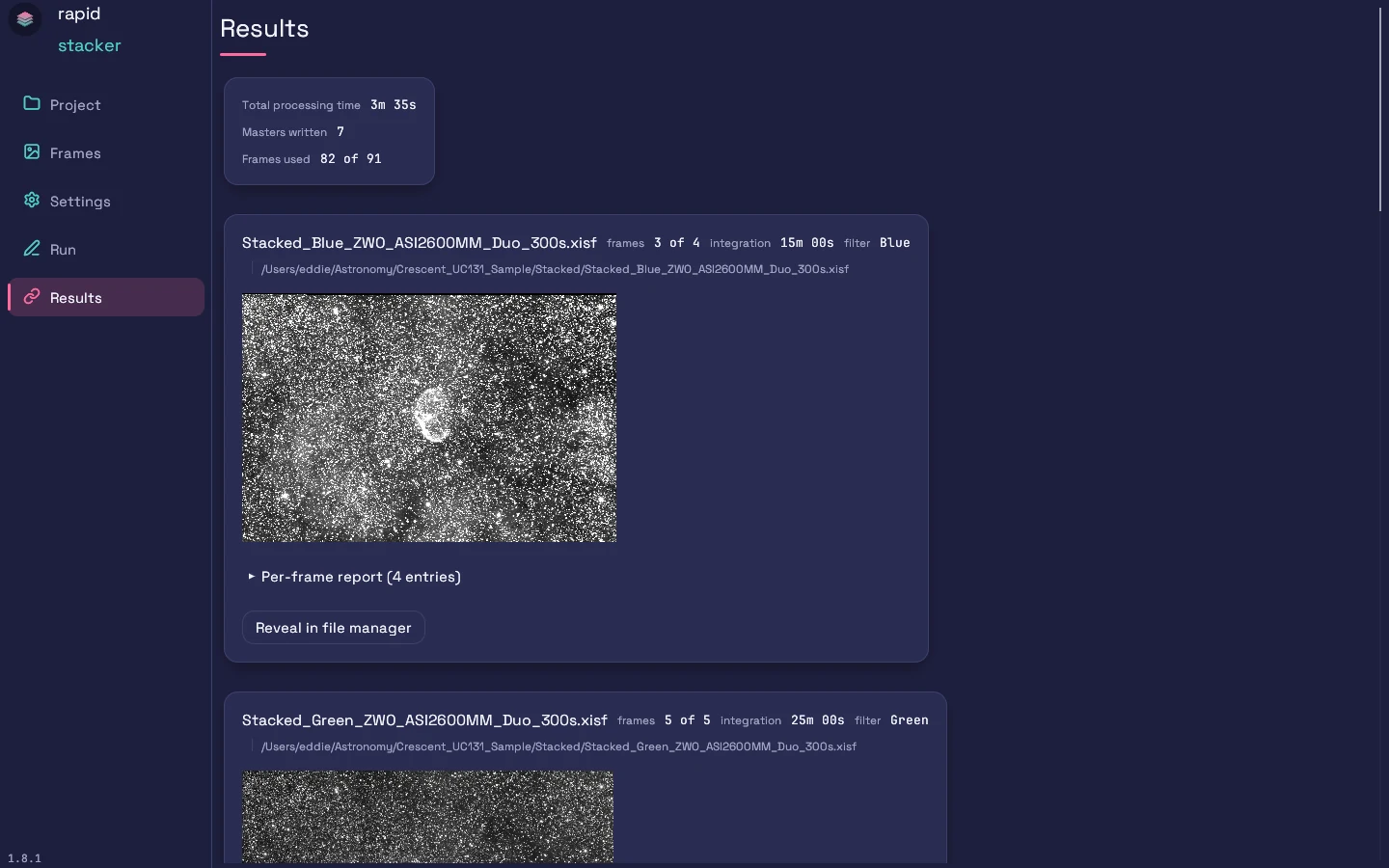
Results screen: one card per stacked group with previews and per-frame reports

GUI wizard

Five steps, zero scripting.

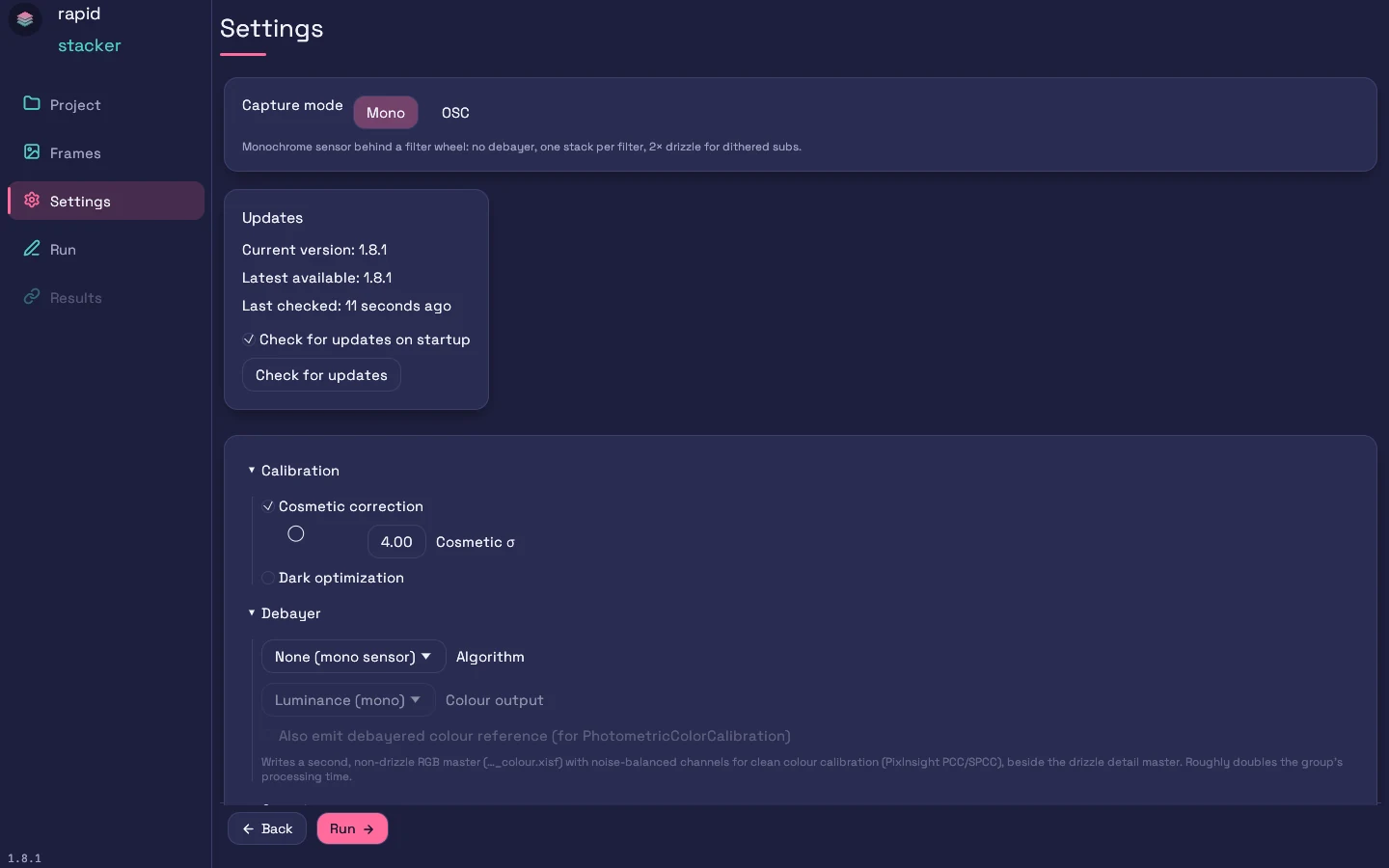
Project picker with folder autofill → Build Masters → frame inspector with per-frame FWHM/eccentricity → one-switch Mono/OSC presets → live run with progress, ETA, in-progress master preview, and graceful cancel. Every setting persists a second after you change it, so a crash never loses your configuration. The same manifest-based, SHA-256-verified auto-updater as Photon Ledger keeps you current.

The whole flow in six steps →

The Settings screen with capture-mode presets and pipeline groups

CLI & automation

Script everything.

rapid-stacker-cli exposes the entire pipeline — build-masters, stack, plus analysis tools: measure (FWHM, eccentricity, star count, SNR), compare-matched (triangle-matched per-star comparison between two masters), and render (shared-stretch previews). Same defaults, same output as the GUI. It ships with every installer, and there is a standalone archive for Linux servers.

CLI reference →

GPU backends

CUDA → wgpu → CPU, automatically.

The auto backend probes NVIDIA CUDA first, falls back to wgpu (Metal on macOS — Apple Silicon is first-class — Vulkan/DX12 on Windows, Vulkan on Linux), and finally to a multi-core CPU path that always works and produces identical results. No NVIDIA driver required, ever.

Every stage included. GPU drizzle, offline plate solving, distortion correction, multi-session alignment, and mosaic assembly all ship in the free download — unlimited frames, no license file. Features & support →
Works with Photon Ledger. Our archive indexer’s Folder Export copies a target’s lights and matched calibration frames into exactly the tree Rapid Stacker consumes. Organize your archive first →
Download free Support development